
Does AI cite your page, or one sentence?
When an AI assistant cites you, it almost never quotes your whole page — it lifts one sentence and binds the citation to that span. This episode goes engine by engine through their own documentation, shows a real 146-character sentence that survives the strictest limit, names the flaw in our own best example, and explains why every free visibility tool reports the page instead.

AI assistants cite one sentence, not your page. ChatGPT records where a citation starts and ends inside its answer, Claude chunks citations by sentence and caps the quoted text at roughly 150 characters, and Perplexity ranks content at the document and the sub-document level. The unit of citation is a self-contained sentence — so that is the unit worth writing.
This is called passage-level citation: the engine retrieves and quotes a span inside your page rather than the page as a whole. Answer Engine Optimization (AEO) is the practice of engineering a website so that AI assistants — ChatGPT, Perplexity, Gemini, Claude — quote it when someone asks them a question. Most AEO advice is written at page level, which is one level too high to be useful. The engine already decided it is taking a fragment; the only open question is which fragment, and whether your name is inside it.
Watch the walkthrough
What do the engines' own documents say about the unit of citation?
Three of them describe a span, not a page, and they describe it in their own developer documentation rather than in somebody's blog post. When ChatGPT cites a source it records a start index and an end index — literally where in its answer that citation begins and ends. Claude is stricter: its citations are chunked by sentence, and the quoted text caps out at around 150 characters. Perplexity, writing about its own search infrastructure, says ranking happens at the document and the sub-document level. Sub-document means the individual passages inside your page are ranked against the question, and the best passage wins on its own.
Why does a cited page not help if your name is not in the sentence?
Because the reader only ever sees the fragment. You optimise a page — headings, length, links, images. The engine reads it, takes eleven words out of the middle, and shows those eleven words to your customer. If your company name is not inside those eleven words, nobody was recommended. Your page was cited; you were not. That is the gap between a visibility report that says you were mentioned and a customer who now knows who you are.
What makes a sentence liftable?
Self-containment. A liftable sentence answers its own heading completely, does not lean on the sentence before it, and names the thing it is about instead of saying "it" or "this". Pull it out of the page, paste it into a conversation with no context at all, and it still makes full sense. This is the pattern we write to at Webappski whenever we rewrite a client's key page: one self-contained answer sentence for every question the page addresses, and the most important version short enough that even the strictest extractor takes the whole point rather than half of it.
What does a real 146-character answer sentence look like?
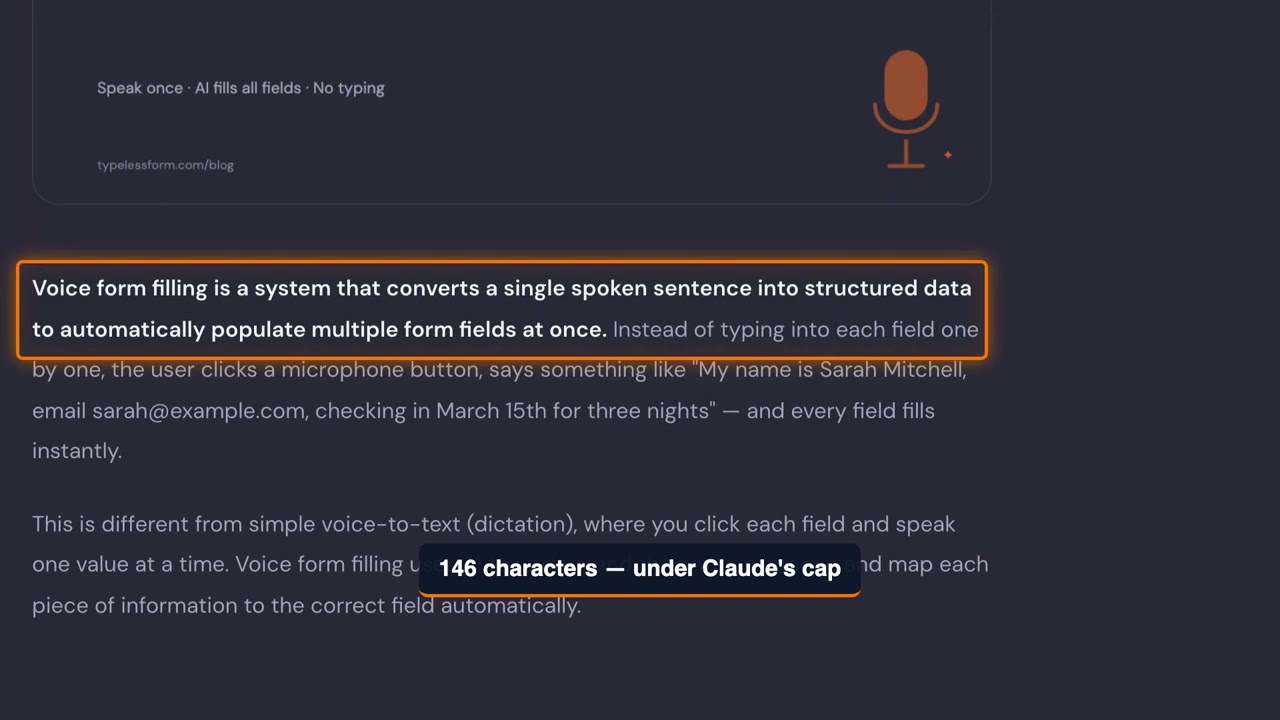
Here is one on a live page, and we picked one of our own so nobody else gets graded. The article is "What Is Voice Form Filling" on typelessform.com, and the first line of the body reads: "Voice form filling is a system that converts a single spoken sentence into structured data to automatically populate multiple form fields at once." That is 146 characters including the full stop — inside Claude's roughly 150-character cap. It answers its own heading, it names the thing it defines, and it survives being lifted out of the page.
Where does our own best sentence fall short?
It names the category and not the brand — and that is a real cost, not a nitpick. If an assistant lifts that sentence, the reader learns what voice form filling is and never learns whose page explained it. A citation that teaches your category to somebody else's customer is a wasted citation. The fix is queued on our own article, and it is exactly the note we would write on a client page: get the defining fact and the name into the same sentence, so the fragment can carry both.
Should the same sentence appear in your structured data?
Yes, and for a plain reason: it costs nothing and it keeps the page honest with itself. On that same TypelessForm article the identical wording is repeated inside the page's structured data as the answer to the question "What is voice form filling?" — readable by a person and machine-readable in the same breath. Do not oversell this, though. Structured data is hygiene, not a citation lever, and no engine has published a measurement that says the markup itself earned the quote. The value is that the visible sentence and the machine-readable one cannot drift apart.
What do the free AI-visibility tools report instead?
The page, every time. We checked three of them on 5 August 2026. Semrush's free checker is generous with access — three runs a day without registering — and returns a visibility score, mentions, citations, platform coverage, competitor comparison and top cited pages. Ahrefs is the same shape and asks for no signup and no credit card: total mentions, mentions by platform, top topics, top cited domains, top cited pages. HubSpot's grader needs no account for a single run and gives a composite score across five dimensions — sentiment, presence quality, brand recognition, share of voice and market competition. None of these tools is bad at what it does. They answer which page. The engine answered which sentence.
Why does our own free check show the answer text?
Because a score cannot tell you which line did the work, and the words can. Our free AI-visibility check shows the answer the engine actually wrote, with the sources it used, so you can read the sentence that got quoted and see whose name is inside it. We will also be straight about the trade: the first verbatim answer is open, and the rest open when you enter an email address. We would rather say that out loud than let you discover it halfway through.
Is it about length, or about self-containment?
Self-containment — and that comes from the engine, not from us. Perplexity, describing its own search infrastructure, says content is split into self-contained spans, each of which can be individually retrieved and ranked at query time. Read what that does and does not say. It says the retrieved thing has to stand on its own once it is lifted out. It says nothing at all about word count. So write for standalone sense first and use the roughly 150-character figure only as the ceiling Claude's extractor imposes. One more honest note: putting a number or a named source inside the same sentence is good craft, and we do it on client pages, but it is not a measured lift. Anyone quoting you a percentage for that practice is quoting a benchmark simulator, not a live engine.
What is the citable-fragment checklist?
Five checks, and we run them on every client page. One: one self-contained answer sentence for each question the page addresses. Two: the key fact and your name inside a single sentence, kept under roughly 150 characters. Three: no "it" and no "this" pointing back at the line before. Four: a number or a named source inside the same sentence wherever you can honestly put one. Five: read it aloud out of context and see whether it still stands up. The habit behind all five is simple — write every important paragraph as if someone will copy exactly one sentence out of it, because that is precisely what the engine does.
Frequently asked questions
Does an AI assistant ever cite a whole page?
It links to a whole page, but it quotes a fragment. The link is what you see in the sources list; the quote is what the reader actually reads. ChatGPT records a start and end index for the cited span, Claude caps the quoted text at roughly 150 characters, and Perplexity ranks passages inside your page separately. Treat the link as the address and the sentence as the message.
How long should a citable sentence be?
Short enough to survive the strictest extractor, which in practice means keeping the most important version under about 150 characters — Claude's cap on quoted text. But length is the ceiling, not the rule. Perplexity's own description of its retrieval says spans must be self-contained and says nothing about length. Write for standalone sense, then check it fits.
Does putting a statistic in the sentence increase citations?
Nobody has measured that on a live engine. The widely-quoted percentage for adding quotes and statistics comes from an academic benchmark run against a simulator, not against ChatGPT, Perplexity, Gemini or Claude, and it predates the 2026 engine changes. Adding a number or a named source is good craft and we do it — we just do not sell it as a measured lift.
Will a free AI-visibility tool tell me which sentence was quoted?
Not the three we checked. Semrush, Ahrefs and HubSpot all report at page or brand level — mentions, cited pages, cited domains, composite scores. That is genuinely useful for knowing whether you appear at all. It cannot tell you which line inside the page did the work, which is the thing you would need in order to fix the page.
Do I have to rewrite every page to do this?
No. Start with the pages that answer a buying question, and rewrite only the opening line of each section on them. One self-contained sentence per question, with the name in it, is usually a morning's work per page — and it is the change most likely to turn a mention into a recommendation.
Want your key pages rewritten so each carries one liftable sentence?
We rewrite key pages so every section opens with one self-contained, quotable sentence that carries your name — and the first AI-visibility audit is free. If you want to see which of your sentences ChatGPT, Gemini and Claude are quoting today, request a free audit at webappski.com.


