
Why does AI cite your competitor instead of you?
A stronger website can still lose the recommendation if a competitor appears on the round-ups, directories and comparisons an answer engine already trusts. This episode shows how to map those sources, qualify them and replace the competitor with evidence worth citing.

AI cites your competitor when trusted third-party sources mention them and omit you. The practical fix is source substitution: ask each engine your buyer’s question, record the pages it cites, and earn an honest place on those exact surfaces with a verified listing, useful data or a stronger comparison.
Source substitution is the AEO practice of identifying the pages an answer engine uses for a commercial answer, then replacing an absent brand signal with verifiable evidence on those same pages or better ones. It is not link buying, bulk directory submission or fabricated mentions. It begins with the engine’s cited sources, not a generic backlink list.
Watch the source-substitution walkthrough
What is source substitution in AEO?
Source substitution means changing the evidence set behind an AI answer, not merely polishing your own homepage. If the engine repeatedly cites a category round-up, an open directory and an evidence-led comparison, those pages define the candidate set. Your job is to qualify for that set honestly or publish a source that deserves to replace a weaker one.
How do you find the pages an AI assistant already trusts?
Ask the exact buyer question and save every cited URL before taking action. Repeat the question across ChatGPT, Perplexity, Gemini and Claude, then group recurring domains by type: editorial round-up, directory, comparison, community thread or first-party evidence. The overlap is your prioritized source map; a guessed list of popular sites is not.
Why can a better website still lose the recommendation?
A better website can lose because it was never present in the retrieved evidence. Answer engines compose commercial answers from a small source set. Strong design and persuasive copy help after discovery, but they cannot compensate when every cited comparison names the competitor and none names your brand.
Which routes to a citation are legitimate?
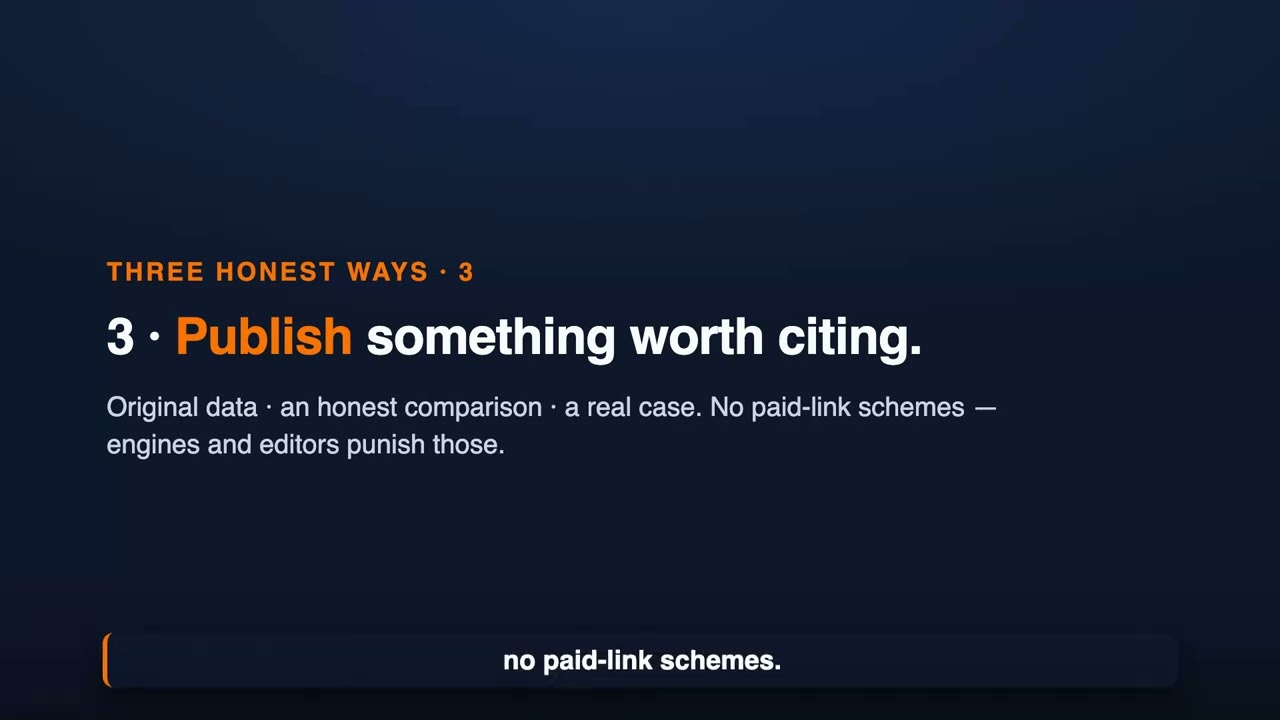
The legitimate routes are rule-compliant listings, editorial inclusion earned by a real fit, and original evidence others choose to cite. Submit only where the platform openly accepts relevant companies. Publish reproducible data, a candid comparison or a case study when no suitable source exists. Never buy links or manufacture community mentions.
Why is source substitution different in a non-English market?
A non-English source map must start with the buyer’s native question. The English query may return mature global round-ups while the Polish or German version surfaces local directories and thinner comparisons. That smaller evidence set is an opening, but only native research reveals it; translating the English source list preserves the wrong market.
Is a listing on Reddit, G2 or Capterra enough?
No single platform is a durable source strategy. G2 and Capterra are real software-discovery surfaces, while Reddit can shape answers through genuine discussion, but any one source can change policy or disappear from retrieval. Build a diversified evidence set across owned proof, editorial sources and a few relevant directories.
Frequently asked questions
Does source substitution mean copying a competitor’s backlinks?
No. It means studying the URLs answer engines actually cite for the buyer question. A conventional backlink export may contain pages that never influence the answer, while the engine’s own citations reveal the evidence set directly.
Should we submit to every directory we find?
No. Use only relevant directories with current, public submission rules and a real audience. Bulk listings create inconsistent profiles and can look like manufactured brand mentions.
What should we record during the source audit?
Record the exact query, language, engine, answer date, cited URL and why the source appears relevant. That evidence lets the next run test whether the candidate set changed instead of relying on memory.
Can our own case study become a substitution source?
Yes, when it shows real methods, dates and outcomes that another writer can verify. A self-promotional claim without evidence is weaker than an honest case study that exposes both the result and its limits.
How soon should we measure again?
Measure after the new source is live and has had time to be crawled. Keep the same query and language so the comparison tests source-set change rather than a different question.
Want the source map for your own buyer questions?
Webappski can run a free AI-visibility check, capture the sources behind your buyer’s answers and show where your competitor enters the evidence set. Start with the free check at webappski.com.


