
How do you start AEO for your website?
You start by examining the site you already have — a five-check diagnostic — then writing one 40–60 word answer-first paragraph for each key page. This episode walks that exact exam on a real, live site, with the full walkthrough below as readable, citable text.

To start AEO for your website, you don't write new pages — you first examine the site you already have. AEO, or Answer Engine Optimization, is the practice of getting your site cited by AI assistants like ChatGPT, Perplexity, Gemini and Claude. This episode walks the exact five-check exam we run on any site, from zero.
AEO (Answer Engine Optimization, sometimes written GEO) is the practice of engineering a website so that AI answer engines quote it when a person asks them a question — not merely so it ranks on Google. For a small business it is usually the cheapest, fastest way to get discovered, and if your market speaks Polish, German or another language where almost no one is doing this yet, the opening is even wider.
Watch the walkthrough
What is AEO, and where do you start?
You start by examining the site you already have, the way a doctor examines a patient — one honest check at a time. In this episode we run that first exam on a real, live website: TypelessForm.com, one of our own products, a voice-to-form widget, and the site we use to prove our method works. We are not showing a polished case study. We are showing the very first thing we do on any site, including our own, when we start its AEO from zero.
Check 1 — Is your site structured so an AI can quote it?
The first check is structure: an answer engine can only cite a page that is built out of real, readable sections, not one long wall of styled text. An engine reads a page the way you would skim it — it looks for clear blocks it can lift a single sentence out of. If everything is one undivided block, the engine has nothing clean to quote, so it quotes a competitor instead.
Check 2 — Is the page fast enough to get recrawled?
The second check is speed, because a slow page is bad for the crawlers that feed AI assistants, not only for visitors. Perplexity runs its own crawler and recrawls on a schedule; a heavy, slow page gets seen less often and less completely. So we open the browser's network panel and watch how quickly the main content actually appears.
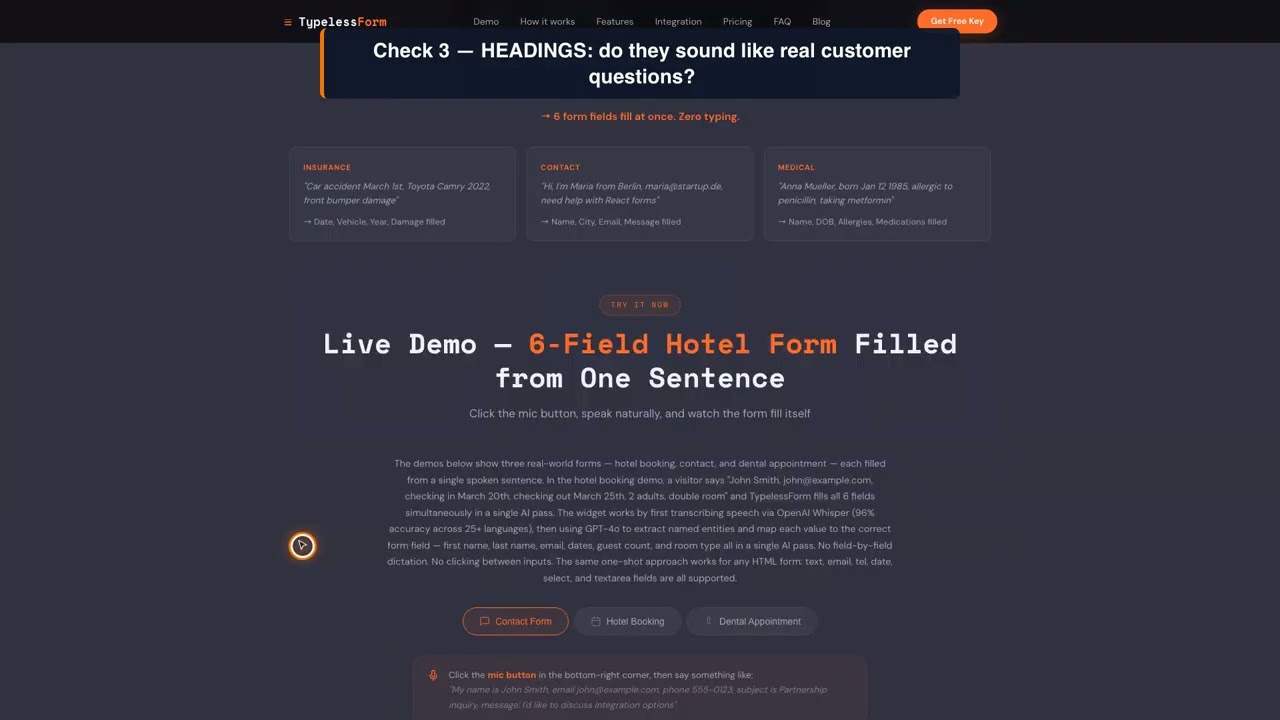
Check 3 — Do your headings match real customer questions?
The third check is headings: read only the headings, top to bottom, and ask whether they sound like the questions a real customer would ask. Not "Our Solutions." Not "Why Choose Us." Actual questions, in the customer's own language. A heading that matches the way someone phrases their question to ChatGPT is a heading that wins the citation.
Check 4 — Is the page's meaning clear in the first two sentences?
The fourth check is meaning: within the first two sentences, is it obvious what this is, who it is for, and what it does? If a human has to scroll to understand the page, an AI engine — which often reads only the top fragment — will misunderstand it completely. The meaning has to live at the top, not be earned by scrolling.
Check 5 — Is the path to action one obvious click away?
The fifth check is the path to action: if someone is convinced, is the single next step one obvious click away? A confused path to action does not hurt your AI visibility directly, but it wastes every visit the AI sends you. There is no point being cited if the visitor lands and cannot find the door.
How do you pick 10 key pages and one question each?
Take the ten most important pages of the site — the home page, the main product page, the pricing page, the most useful articles, About, Contact — and for each write the single most important question that page should answer. One page, one question. If we cannot name the question a page answers, that page is not earning its place, and an answer engine will treat it as noise.
How do you write the answer-first paragraph?
For each of those ten pages, write the answer to its question as a short paragraph — between forty and sixty words — placed right at the top, before any introduction. Plain language, the direct answer first. This is the paragraph the AI assistant lifts and quotes. Most sites bury their answer under a paragraph of warm-up; we put it first, because the engine reads the top and stops.
SEO or AEO — which comes first?
You do not choose between them; you put them in the right order. Search engine optimization leads a customer to the door, and AEO is what opens the door. Structure first, an honest exam second, then one clear forty-to-sixty-word answer per key page. That is how a small business starts showing up in AI answers, on a small budget, without writing a single new page on day one.
Frequently asked questions
What does AEO stand for?
AEO stands for Answer Engine Optimization — engineering a website so AI answer engines like ChatGPT, Perplexity, Gemini and Claude cite it when someone asks a relevant question. It is sometimes written GEO (Generative Engine Optimization); most small-business owners simply call it "showing up in ChatGPT" or "getting found in AI search."
Do I need to write new pages to start AEO?
No. You start with the site you already have. The first moves are a five-check diagnostic — structure, speed, headings, meaning, and the path to action — and then one 40–60 word answer-first paragraph at the top of each key page. New pages come later, if at all.
How is AEO different from SEO?
SEO aims to rank a page in a list of blue links; AEO aims to be the passage an AI assistant quotes inside its answer. They share foundations — clean structure, fast pages, honest content — but AEO adds an answer-first paragraph and structured data so an engine can lift a self-contained sentence. SEO leads a customer to the door; AEO opens it.
Which AI assistants does this help with?
The same foundations help across ChatGPT, Perplexity, Gemini and Claude, because each one reads a page for a clean, quotable passage. The exact levers differ per engine — Perplexity crawls its own index, Gemini leans on entities, ChatGPT reads what it can crawl and index — but a well-structured, answer-first page is the common denominator every engine rewards.
Do I need a big budget to start?
No. The first day of AEO costs attention, not money: the five-check exam and one answer-first paragraph per key page use the pages you already have. If your market speaks Polish, German or another language where few competitors are doing this yet, a small, careful effort goes even further.
Want this exact exam run on your own site?
We run this same five-check exam, page by page, on real client sites — and the first AI-visibility audit is free. If you want to see where your site stands with ChatGPT, Perplexity, Gemini and Claude, request a free audit at webappski.com.


