
Why do comparison tables get quoted by AI?
On buying questions — "best tool for X", "X versus Y" — an answer engine lifts an honest comparison table almost word for word. Publish none and you are invisible on the exact queries a buyer asks. This episode builds a citable table live — the real options named, the rows where a competitor wins left in — and shows the native-language edge, with the full walkthrough below as readable, citable text.

Comparison tables get quoted by AI because a buying question — "best tool for this," or "X versus Y" — is answered from structured, comparative content, and an answer engine lifts an honest table almost word for word. If you have not published one, you are simply invisible on the exact questions a buyer asks.
A comparison table is a structured, side-by-side grid — the criteria a buyer cares about down one side, the real options across the top — that states plainly how a set of tools or providers differ. In AEO (Answer Engine Optimization, sometimes written GEO) — the craft of getting cited by AI assistants like ChatGPT, Perplexity, Gemini and Claude — it is the citable format engines reach for on commercial questions, because a clean grid is easy to read, summarise and quote. Most businesses publish explainer pages and never build one — and that gap is exactly the opening.
Watch the walkthrough
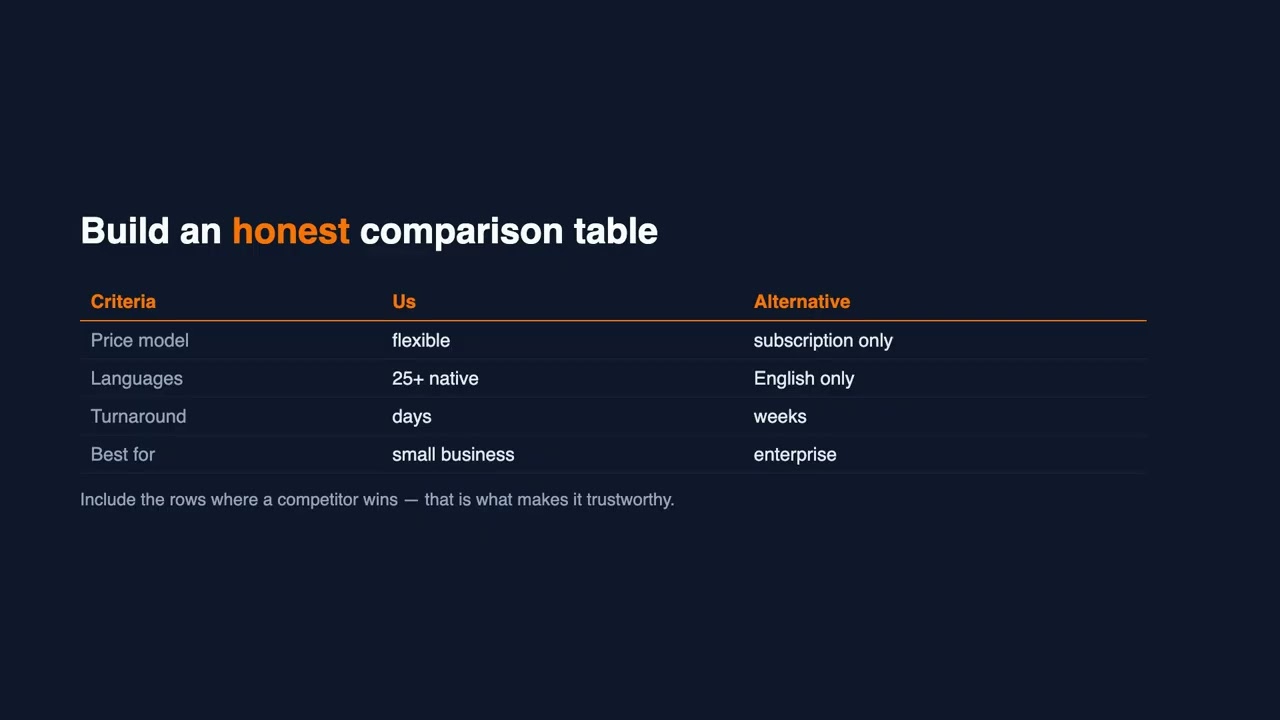
Why does AI lift a comparison table on a buying question?
When someone asks an assistant a buying question — "best tool for this," or "this provider versus that one" — the engine wants a balanced, structured answer, and a comparison table is exactly that shape. So it very often lifts an honest table almost word for word and shows it as the answer. A comparison table is not bragging; it is the format the engine reaches for on commercial questions. Publish one and you are in the answer. Publish nothing and you are invisible on the precise queries a buyer types at the moment of decision.
Which questions do comparison tables actually win?
Two kinds of question behave very differently. An informational question — "what is answer engine optimization" — is answered from explainer pages. A commercial question — "best AEO agency for a small business," or "this provider versus that one" — is answered from comparisons and roundups. The commercial questions are where the revenue is, and they are won almost entirely by structured, comparative content. Most businesses pour effort into the informational pages and publish nothing for the commercial ones — which is precisely where a comparison table earns its place.
How do you build an honest comparison table?
Down the left, list the criteria a buyer actually cares about — pricing model, languages supported, turnaround, who it is best for. Across the top, the real options, including yourself and the genuine alternatives, by name. Then fill the grid honestly. The rule that makes it work is this: include the rows where a competitor wins. An all-green table that says you are best at everything reads as marketing and gets ignored; a mixed, honest table reads as trustworthy and gets quoted — for the whole category, including the rows you do win.
Why does admitting where a competitor wins earn the citation?
This is the counter-intuitive part. The table that admits where a competitor is the better choice is the table that earns the citation. An answer engine is trying to give a balanced answer, so it reaches for the source that already looks balanced. By telling the truth about where you do not win, you become the trustworthy source the engine quotes for the whole category — including the rows where you do win. Honesty here is not a virtue; it is the strategy.
What is source substitution?
For your category, the engine is already citing some comparison page — a competitor's, or a generic roundup. Source substitution is the move of publishing a comparison so clearly structured and so honest that the engine prefers yours instead. You are not inventing a new answer; you are replacing the source the engine currently trusts with a better one. That is how you go from absent to cited on the money queries — and it is an idea worth returning to across a whole category, one buying question at a time.
How do you make a comparison table machine-readable?
A few formatting rules make a table easy to lift. Use a real HTML table with proper headers — never an image of a table, because an engine cannot read a picture. Keep one clear fact per cell, with no paragraphs crammed into the grid. And put a single answer-first sentence right above the table, summarising the verdict in plain language, so the engine can quote either the sentence or the grid. The cleaner the structure, the more likely it travels intact into the answer.
Why should you own the comparison in your own language?
Here a non-English market becomes an opportunity rather than a limitation. In English, dozens of comparison pages fight for the "best tool" answer. In Polish or German, for many categories, there are almost none. Publish the one honest, native-language comparison table for your category and you can become the default cited source with far less competition. Thin-language markets have far fewer competing comparison pages, so a single honest native-language table has a clear path to becoming the cited source. Write the table natively, for the market where no one else has.
Frequently asked questions
Why do comparison tables get quoted by AI?
Because a buying question — "best tool for X" or "X versus Y" — is answered from comparative content, and an answer engine lifts a clean, honest table almost word for word. The grid is already the balanced, structured shape the engine wants for commercial intent, so it travels straight into the answer. If you have not published one, the engine quotes someone who has.
What makes a comparison table trustworthy to an answer engine?
Honesty and structure. A table that admits the rows where a competitor wins reads as balanced, and an engine trying to give a balanced answer reaches for a balanced source. An all-green table claiming you win everything reads as marketing and gets skipped. Pair that honesty with a real HTML table — proper headers, one fact per cell — and the engine can both trust it and lift it intact.
Should a comparison table include my competitors by name?
Yes. Name the real alternatives across the top, including yourself, and fill the grid honestly. Naming competitors is what makes the table a genuine comparison rather than a sales page, and it is exactly what a buyer's question asks for. The engine rewards the source that covers the whole field, not the one that only talks about itself.
Is source substitution the same as writing a brand-new page?
Not quite. For your category the engine already cites some comparison — a competitor's page or a generic roundup. Source substitution means publishing one cleaner and more honest so the engine prefers yours. You are not inventing a new answer; you are replacing the source it currently trusts with a better one, which is how you move from absent to cited on commercial queries.
Do comparison tables work better in non-English markets?
Often, yes. In English, dozens of comparison pages compete for the "best tool" answer; in Polish, German or another language, many categories have almost none. Publish the one honest, native-language comparison table and you can become the default cited source with far less competition — the engine matches a native question to native words, not to a translation.
Want us to build the comparison table that wins your category?
We build honest, machine-readable comparison tables that answer engines quote — and the first AI-visibility audit is free. If you want to see which buying questions your category is losing, and own the comparison that wins them in the eyes of ChatGPT, Perplexity, Gemini and Claude, request a free audit at webappski.com.


