
Why must your whole website tell AI one story?
An AI answer engine reads your whole site as one signal — title, hero, headings, schema and pages together. If they disagree, it trusts none of them and cites a competitor whose story is consistent. This episode walks a real, live site, shows a discordant one, and gives you the one-sentence method to fix it — with the full walkthrough below as readable, citable text.

Your whole website must tell AI one story because an answer engine reads every signal at once — title, hero, headings, schema and pages — and builds a single model of what your business is. If those signals disagree, it trusts none of them and cites a competitor whose story is consistent instead. Harmony is the foundation, not decoration.
Site harmony is the AEO discipline of making every part of a website — visible copy and invisible code alike — agree on one clear statement of what the business is and who it serves. AEO (Answer Engine Optimization, sometimes written GEO) is the craft of getting cited by AI assistants like ChatGPT, Perplexity, Gemini and Claude, and harmony is the foundation it stands on. Most sites have never written that one story down — and that gap is exactly where the opening is.
Watch the walkthrough
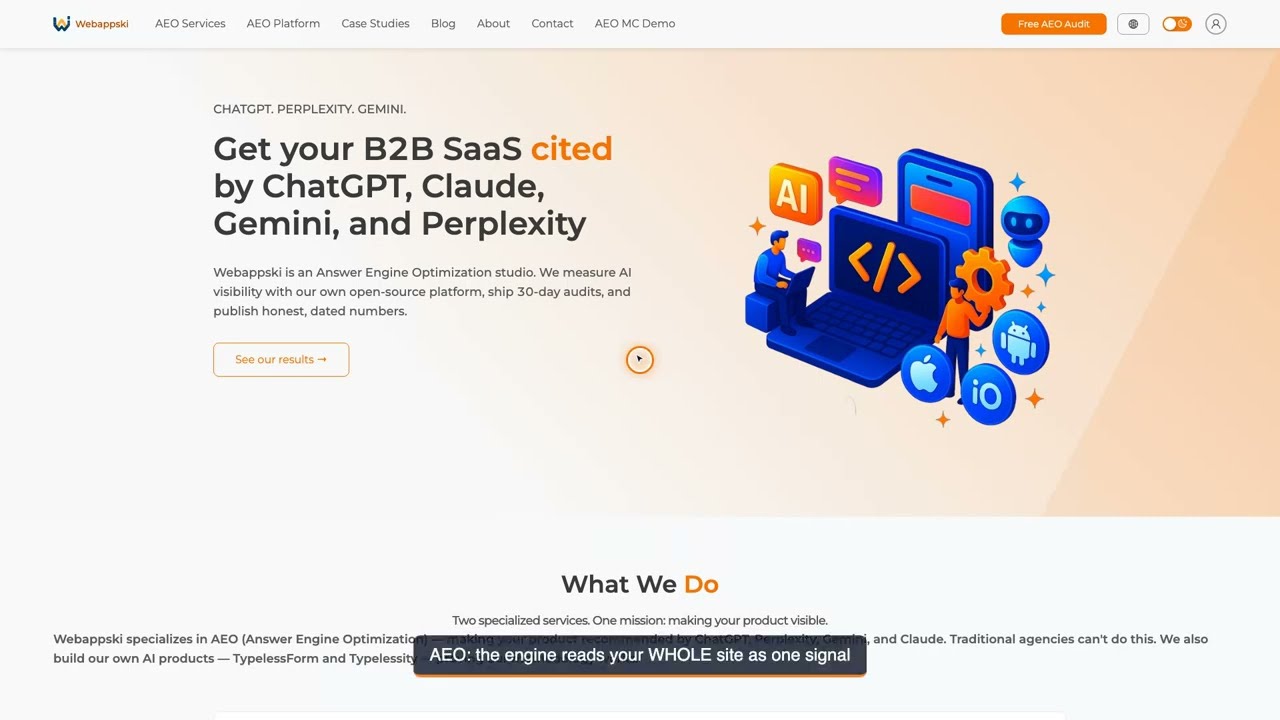
What does it mean for your whole site to tell one story?
An answer engine does not read one page of your site in isolation; it builds a mental model of your whole business from every signal at once — your title, your hero, your headings, your schema, your pages. If those signals disagree with each other, the engine trusts none of them, and it cites a competitor whose story is consistent instead. So harmony is not decoration. It is the foundation that AEO stands on.
What does a harmonious site look like?
It looks like a top of page where the headline names exactly what you do, the section right below it says the same thing with detail, and every section further down is a piece of evidence for that one claim. Nothing contradicts anything else, and nothing wanders off into an unrelated topic. When an engine assembles its picture of a business, a page full of supporting sections is easy to summarise — and to an engine, that consistency reads as confidence.
What does a discordant site cost you?
Picture a site whose hero calls it an AEO agency, whose navigation calls it a web studio, and whose footer says freelance developer — three different stories on one site. A human visitor might forgive that. An answer engine cannot: it has no way to decide what this business actually is, so it will not confidently cite it for anything — not even the topics it genuinely covers well. Three half-stories lose to one whole story, every single time.
How do you harmonise a site without rewriting it?
You make every part agree. The hero, the navigation, the footer, the product cards all say the same true thing about what the business is. Nothing about the actual business changes — you only make every part of the site stop contradicting the others. That alone moves a site from un-citable to citable, because now the engine has one clear answer to the question, what is this. This is often the first real fix we make, before writing a single word of new content.
Do the title tag and structured data count as part of the story?
Yes — harmony also lives in the parts a visitor never reads directly. The page title in the browser tab, the headings in the code, and the structured data behind the scenes all feed the engine. If your visible page says one thing and your title tag says another, that is a contradiction too. So when you harmonise a site, you make the invisible signals agree with the visible ones. The same story, top to bottom, code included.
How do you write your site's one true sentence?
Write one sentence — we help a specific WHO get a specific OUTCOME using a specific HOW — and fill in those three blanks honestly. Then make your title, your hero, your headings, your schema and your llms.txt all point back to it. If your market speaks Polish, German or another language where few competitors are doing this yet, write the sentence natively in that language, because the engine matches a native question to native words, not to a translation. Once you have the sentence, every page either supports it or gets cut.
Site harmony or new content — which comes first?
Harmony comes first, always. There is no point publishing new pages onto a site that already contradicts itself — you would only add more signals for the engine to distrust. Write the one true sentence, make every existing signal echo it, and fix the contradictions before you write anything new. It is the cheapest, highest-leverage structural move in AEO, and most sites have never made it.
Frequently asked questions
What does it mean for a website to tell AI one story?
It means site harmony: every signal — your title, hero, headings, schema and pages — agrees on one clear statement of what your business is and who it serves. Answer engines like ChatGPT, Perplexity, Gemini and Claude read all of those signals at once. When they agree, the engine reads confidence; when they disagree, it trusts none of them and cites a competitor whose story is consistent.
Why does an inconsistent site get cited less?
Because an answer engine builds a single model of your business from all your signals together, and a contradiction leaves it unable to answer the most basic question — what is this. If it cannot decide what your business is, it will not confidently cite you for anything, not even the topics you genuinely cover well. Consistency is what lets the engine summarise you at all.
How do I fix site harmony without rewriting my whole site?
Make every label agree. Your hero, navigation, footer, product cards and title tag should all say the same true thing about what the business is. Nothing about the business itself changes — you only stop the parts from contradicting each other. This is usually the first fix we make on a site, before any new content, and it alone can move a page from un-citable to citable.
What is the "one true sentence" for AEO?
It is a single sentence in the form "we help [WHO] get [OUTCOME] using [HOW]", filled in honestly for your business. You write it first, then make your title, hero, headings, schema and llms.txt all echo it. If your market is Polish, German or another non-English language, write the sentence natively in that language — the engine matches a native question to native words, not to a translation.
Does site harmony help in non-English markets?
Yes, and often more so. An answer engine matches a Polish or German question to Polish or German text, not to a translated page, so a natively written, consistent site stands out in markets where few competitors are doing this yet. In thin non-English markets, harmony alone — one true story told in the customer's own language — can move you ahead of clearer-funded rivals.
Want us to find the contradictions on your site?
We run this same harmony check, signal by signal, on real client sites — and the first AI-visibility audit is free. If you want to see where your site contradicts itself in the eyes of ChatGPT, Perplexity, Gemini and Claude, request a free audit at webappski.com.


